

12.09.2014
 Forschungsaustausch auf der GMDS-Jahrestagung in Göttingen
11. September 2014
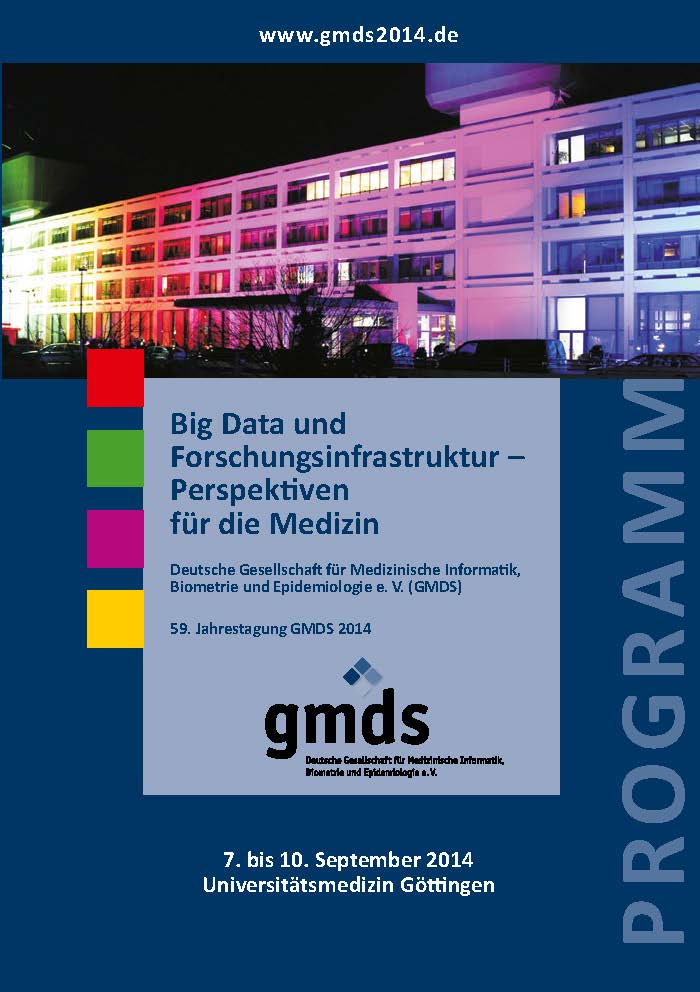
Die 59. Jahrestagung der Gesellschaft für Medizinische Informatik, Biometrie und Epidemiologie e.V. (GMDS) versammelte in diesem September wieder zahlreiche Wegbereiter der Digitalisierung im Gesundheitsbereich. Die vom BMBF als Veranstaltung des Wissenschaftsjahres 2014 deklarierte Jahrestagung stand ganz im Zeichen von „Big Data und Forschungsinfrastruktur – Perspektiven für die Medizin“.
Aus dem ICCAS nahmen fünf Wissenschaftler, darunter GMDS-Präsidiumsmitglied Prof. Thomas Neumuth, teil. Referate hielten Dr. Kerstin Denecke (DPM) über Digitale Patientenmodelle zur Entscheidungsfindung in der Modellbasierten Medizin sowie Yihan Deng (DPM) zum Thema „Summarization of EHR Using Information Extraction, Sentiment Analysis and Word Clouds“.
11 September 2014
This September, the 59th Annual Meeting of the German Society for Medical Computer Science, Biometry and Epidemiology (GMDS) e.V. brought together again numerous pioneers of the digitalization in the healthcare sector. Declared from the BMBF as an Event of the Year of Science 2014 the annual meeting was entirely dedicated to the motto “Big Data and research infrastructure – perspectives for medicine.”
Five scientists from the ICCAS took part, among them GMDS-committee member Prof. Thomas Neumuth. Presentations were given by Dr. Kerstin Denecke (DPM) on digital patient model for decision support in model based medicine and Yihan Deng(DPM) on the topic “Summarization of EHR using information extraction, sentiment analysis and word clouds“.

09.09.2014
Präsentationen auf der MIE 2014
09 September 2014
The ICCAS participated at the 25th European Medical Informatics Conference (MIE 2014) with two conference contributions from the research field Digital Patient- and Process Model. Dr. Kerstin Denecke and Yihan Deng traveled to Instanbul to present their concepts for analysis and modeling of patient data.
Dr. Denecke’s lecture dealt with the analysis of the linguistic features of medical weblogs, particularly against the background including such information in a digital patient model. Deng spoke about the visualization of unstructured patient data for the evaluation of diagnoses and courses of treatment.
[nggallery id=15]

Karl-Heinz-Höhne-Preis und Dissertation – Frank Heckel gleich zweimal erfolgreich
09 September 2014
As in 2012, a researcher of the ICCAS could receive the award for the 2nd place of the Karl-Heinz-Höhne-Preis (MedVis-Award). Frank Heckel got the honor, which is awarded every two years from the Visual Computing for Biology and Medicine (VCBM) Group, for his scientific work on interactive post-correction of automatically generated segmentation results in oncology. The computer scientist from the Fraunhofer-Institut für Bildgestützte Medizin (MEVIS) has been working as guest researcher at the ICCAS for over one year. Here, he analyzes image qualities for the collaborative project OR.NET and supports the cooperation between the ICCAS and the Fraunhofer MEVIS within the scope of the OR.NET-initiatives.
Four days after the award ceremony, Frank Heckel could celebrate another professional success. He defended his doctoral thesis entitled “Sketch-Based Interactive Segmentation and Segmentation Editing for Oncological Therapy Monitoring“ at the Jacobs University Bremen. In this work, he dealt with methods for more accurate and reproducible volumetric measurements of tumors in computer tomography data. The procedures were developed to support radiologists evaluating the effective of chemotherapy. Heckel’s success at the MedVis-Award is based on findings of the dissertation.
The ICCAS congratulates to the outstanding achievements and looks forward to another year, from now on with Dr. Frank Heckel in the research team.
[nggallery id=16]
01.09.2014
Sandra von Sachsen mit Vortrag auf ICBES in Prag
01 September 2014
Sandra von Sachsen was speaker at the International Conference on Biomedical Engineering and Systems (ICBES) in Prague. At the specialist conference, researchers met who deal with theories and applications of biomedical sciences and biomedical engineering.
Von Sachsen’s lecture on computer-assisted defect classification for the treatment of cervical spinal stenosis presented important research results of the HWS-group – a coding scheme for the description of identified defect characteristics of degenerative modified cervical spinal stenosis and a method for the fully automated detection of stenosis of the spinal canal in the MRT image. The audience asked questions concerning the applicability of the method in the diagnosis of vertebral body fractures. According to Sandra von Sachsen, this is quite possible. A crucial prerequisite is the providing of a greater amount of image data for the image-based classification of the relevant vertebral fractures.
09.08.2014
ICCAS-Workshop zum Teilprojekt 6 – Demonstratoren im OR.NET
09. August 2014
OR.NET ist ein vom Bundesministerium für Bildung und Forschung gefördertes Verbundprojekt und steht für „sichere dynamische Vernetzung in Operationssaal und Klinik“. Das ICCAS – von Beginn an Partner in fast allen Teilprojekten – arbeitet seit Anfang des Jahres im Teilprojekt 6 an der Koordinierung des Aufbaus aller Demonstratoren sowie an der Erstellung des Integrationsdemonstrators am Standort Leipzig.
Ca. 20 Partner, darunter Vertreter namhafter Medizintechnikfirmen, Hersteller klinischer Informationstechnologien, Anbieter integrierter Operationssäle sowie Wissenschaftler aus Forschungsinstituten, sind am Teilprojekt 6 beteiligt. Deren Synchronisierung findet regelmäßig in Workshops statt. So auch jenem, der Ende Juli von den Teilprojektleitern Max Rockstroh (ICCAS) und Markus Birkle (UKL Heidelberg) am ICCAS organisiert wurde. Es gab hauseigene Vorträge zum Thema Workflowmanagement und Vorträge der Partner zu den gegenwärtigen Arbeiten an zentralen Komponenten der Open Surgical Communication Platform (OSCP). Zudem wurden die aktualisierten Versionen der Storyboards (Drehbücher) für die Demonstratoren vorgestellt. Die Demonstratoren dienen dazu, die im Gesamtprojekt entwickelten Konzepte und Systeme später in einer realitätsnahen Umgebung anzuwenden.
Der Workshop bot genügend Raum für konstruktive Lösungsvorschläge. Zudem nutzten Teilnehmer die Gelegenheit, den gegenwärtigen Demonstrator-OP des ICCAS in Augenschein zu nehmen.

09 August 2014
OR.NET is a collaborative project funded by the Federal Ministry of Education and Research and stands for “Secure and dynamic networking in the operation room”. From the very start, the ICCAS has been partner in nearly all sub-projects of this lighthouse project. Since the beginning of this year, the ICCAS has been working on the coordination of the construction of all demonstrators and on the establishment of the integration demonstrator at the Leipzig location.
About 20 partners including representatives of renowned medical technology companies, manufacturers of clinical information technology, provider of integrated operating rooms as well as scientists from research institutes are involved in the sub-project 6. The synchronization of the partners takes regularly place in workshops. At the end of July, such a workshop was organized by the subproject leaders Max Rockstroh (ICCAS) and Markus Birkle (UKL Heidelberg) at the ICCAS. The workshop included in-house presentations on workflow management and guest lectures about the current work on the central components of the Open Surgical Communication Platform (OSCP). Furthermore, updated versions of the storyboards for the demonstrators were presented. The demonstrators will be used to apply the overall project concepts and systems in a realistic environment.
The workshop on sub-project 6 left enough room for proposed solutions. Besides, participants took the opportunity to inspect the current demonstrator–OR.
08.08.2014
Dr. Kerstin Denecke bringt Leipzig – Auckland – Forschungsvorhaben ins Rollen
08 August 2014
Last year in autumn, employee of New Zealand’s National Institute for Health Innovation (NIHI) visited the ICCAS to explore common research interests. They already showed interest in working together with the ICCAS at that time. Now the return visit followed by Dr. Kerstin Denecke, who traveled to Auckland with plenty information material about the ICCAS and the work of the research group Digital Patient- and Process Modell. Her points of reference were the NIHI – where studies for information technologies in the healthcare sector are conducted – and the Department of Computer Science at the University of Auckland. Furthermore, an initial meeting with the Bioengineering Institute took place which also deals with patient modelling.
The conversations at the NIHI were successful. Both sides see benefits in a closer cooperation. While the Leipzig scientists are leading in methodical development, the Auckland researchers have much to offer in the field of patient studies. The reason for that is a good availability of patient data gathered over decades. Just as the ICCAS, the National Institute endeavors developments of standardized applications which use openEHR – a good reason to remain in contact.
Further research periods are planned. The Leipzig – Auckland – Research is taking shape.
23.07.2014
Dabeisein während der Digital Operating Room Summerschool (DORS) des ICCAS
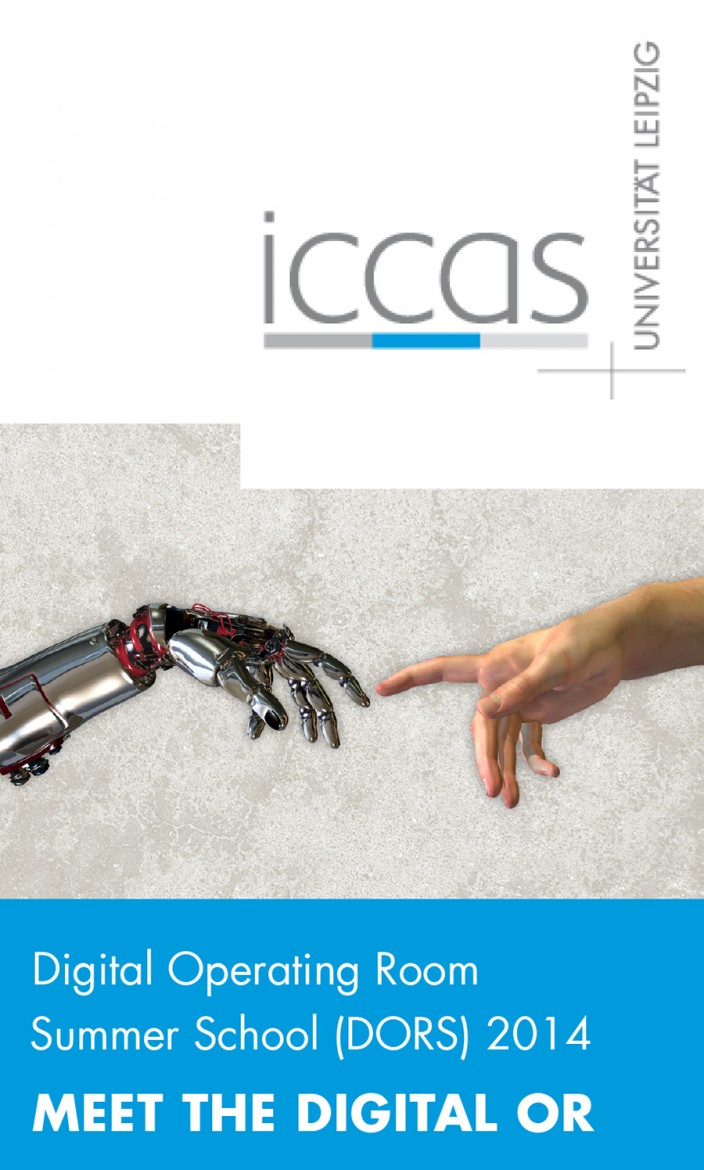 Wenn am 22. September 2014 die Summerschool des ICCAS für eine Woche ihre Türen öffnet, erwartet die Teilnehmer ein reich gefülltes Programm, das die Entwicklungen und Herausforderungen im Bereich Informationstechnologie für den digitalen Operationssaal zum Gegenstand hat.
In den Räumlichkeiten des neuen Augusteums sowie der Bibliotheca Albertina werden erfahrene Wissenschaftler aus der Medizin, dem Ingenieurwesen und der Informatik ihre Erfahrungen auf den Gebieten medizinische Bildverarbeitung, Computer Vision und IT-Technologien weitergeben und den Teilnehmern beratend zur Seite stehen. Zudem sprechen Klinikbetreiber über Möglichkeiten der Umsetzung neuer IT-Infrastrukturen in ihren Häusern. In einem praktischen Teil werden die Teilnehmer in die menschliche Physiologie und Anatomie eingeführt. Eine Hospitation im OP soll Arbeitsabläufe und Technologien näher bringen. Im ICCAS Konzept-OP können schließlich neueste Entwicklungen anhand von Prototypen und Simulatoren selbst getestet werden.
Angesprochen sind vor allem junge Wissenschaftler und Doktoranden, die sich den neuen Anforderungen an eine personalisierte Medizin mithilfe anwendbarer technologischer Assistenz stellen und dazu Expertenkenntnisse aus erster Hand erfahren möchten. Aber auch alle anderen Interessenten, die den direkten Austausch innerhalb der wissenschaftlichen Community im Bereich computerassistierte Chirurgie suchen, sind herzlich willkommen.
Die Teilnehmerzahl ist begrenzt. Anmeldungen können bis einschließlich 31. 08. 2014 erfolgen.
Das ICCAS freut sich auf lehrreiche Tage in Leipzig, in denen auch das gegenseitige Kennenlernen nicht zu kurz kommen soll.
Weitere Informationen sowie das Anmeldeformular zur DORS gibt es unter www.iccas.de/dors.
When the ICCAS – Summerschool will open its doors for one week on 22nd September 2014, participants can expect a richly filled program which has the developments and challenges in the field of information technology for the digital operating room as subject matter.
In the premises of the new Augusteum and the Bibliotheca Albertina, experienced scientists from medicine, engineering and computer science will share their experiences in the fields of medical image processing, computer vision and IT-technologies. They will also provide advisory support to the participants. Furthermore, hospital operators speak about the possibilities of implementing new IT-infrastructures in their institutions. During a practical session participants will be introduced into the human physiology and anatomy. An operating room visit will show the current state of the art OR-technologies and workflows in practice. Latest developments can finally be tested on prototypes and simulators in the ICCAS Concept-OR.
Especially young researchers and Ph.D. students should feel concerned who want to face the new requirements on personalized medicine and who want to receive firsthand knowledge from experts. But all other interested persons who are looking for a direct exchange within the scientific community of computer-assisted surgery are very welcome.
The number of participants is limited. Registrations can be submitted until 31st August 2014.
The ICCAS is looking forward to informative days in Leipzig where also the mutual acquaintance should not be neglected.
Further information and the registration form can be found under: www.iccas.de/dors.
DPM-Beitrag auf 37. ACM SIGIR Konferenz in Australien
23 July 2014
Information processing and knowledge management are important workspaces of the DPM research area. Sentiment Analysis of clinical texts is one part of it and the specialty of Yihan Deng. The computer scientist reported about the current research results of this rather unusual method of information retrieval in the medical field at this year’s International ACM SIGIR Conference in Gold Coast (Australia). Among the participants was also DPM junior research group leader Dr. Kerstin Denecke, who is involved in the investigations just like the physician Matthäus Stöhr. The scientists prove that medical records are far away from being objective data sets. They rather include important observations and assessments of the clinical staff about the current health situation of the patients. This allows deducing indications for further therapeutic measures. The sentiment analysis can thus provide important information for the digital patient model which otherwise would remain hidden in the patient records.
The conference – organized by the Association for Computing Machinery (ACM) and the Special Interest Group on Information Retrieval (SIGIR) – is one of the most important events on the topic of “Information Retrieval”. Here, scientists come together who are concerned with the recognition, organization, storage, retrieval and distribution of information in public and private sectors.
[nggallery id=14]
11.07.2014
ICCAS empfängt russische Delegation
10 July 2014
A delegation of academics, physicians and students from the Faculty of Fundamental Medicine of the Buryat State University in Ulan-Ude visited the ICCAS on 9th July 2014.
After Professor Thomas Neumuth had warmly welcomed the guests from the capital of the Russian Republic of Buryatia, Mario Cypko and Stefan Franke gave insights into current research work at the ICCAS. Mario Cypko presented previous results and further projects relating to the digital patient model. He initiated the guests into the development and use of Multi-Entity Bayesian Networks for improving the therapeutic decision making. Following, interesting questions about actuality and scope of the applicability and about privacy had to be answered.
During the live demonstration in the ICCAS concept-OR Stefan Franke was closely surrounded by the participants. Whether surgical milling tool, ultrasound with navigating puncture needle or navigation system for ENT surgery – the modern devices were carefully examined. Unfortunately, the guests had very little time in their bags, because the ICCAS was only one of many program points of the Leipzig stay.
The Buryat State University is one of the oldest universities in Siberia and an important establishment for modern science and higher education in the Russian Republic. Professors and students of the Faculty of Medicine regularly organize fact-finding trips to technologically advanced institutions in Germany and other European countries to promote the concept of Integrative Medicine using traditional and modern methods of treatment and innovative technologies and to forge collaborations.
[nggallery id=13]
03.07.2014
Erfolgreiche Präsentation auf dem International Congress of Computer Assisted Radiology and Surgery
03 July 2014
With visionary thoughts in mind the ICCAS participants of the 28th CARS-Congress returned to their research places.
Both the own technical contributions and the visits of other sessions and presentations strongly boosted the dialogue with international medical experts and clinical informatics. After his lecture on system development for the modeling of medical treatment decisions Mario Cypko received a cooperation request from an institute in Moscow. Furthermore, he could take new approaches and solutions to ethical questions for his project, concerning computer-assisted therapeutic decisions.
Matthäus Stöhr’s tumor board – analysis from a researching clinician’s point of view also met with great response. An US American company sees great potential in the information models and is striving for cooperation with the ICCAS.
Also Philipp Liebmann found suggestions for the further research work of the Standard-group. In his lecture on the status of DICOM and IHE in surgery, he presented existing solutions as well as data objects and IHE-profiles currently under development. During the DICOM WG 24 Meeting further development approaches were discussed.
[nggallery id=12]